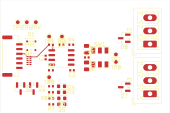
Pre-fab review report
revise first
Schematic intent is coherent. Release risk is still real.
Findings
J2/J3 assembly part does not appear to match the PCB footprint.
findingJ2 J3Evidence: BOM uses 1840379 / C480579. The PCB footprint is Phoenix MCV 1x03 vertical header style, whose library description references header order 1843619.
Action: Choose the exact assembled connector. Update the BOM to the PCB header, or change the footprint if the populated part is different.
J2/J3 connector evidence
The schematic side shows the two external CAN connector blocks; the report ties this to the assembled connector and PCB footprint mismatch.
CAN TVS part is a normal-capacitance substitute.
candidateD7 D8Evidence: LCSC C39832198 resolves to ElecSuper PESD2CANFD24V-TR. Its datasheet lists CJ 18 pF typical, 35 pF max and calls the part Normal Capacitance ESD. Two devices sit on the CAN pair.
Action: Use a proven low-cap CAN FD TVS, or explicitly accept this capacitance and clamp tradeoff after signal-integrity review.
TVS capacitance check
The highlighted TVS diode matches a generic part number with higher capacitance than typical for CAN FD.
CAN netclass looks broader than the electrical intent.
candidateconstraintsEvidence: Copper reports GND and split-termination local nets in the CAN class. KiCad DRC still applies CAN clearance checks to nearby local pads.
Action: Make release constraints explicit: usually /CAN_P and /CAN_N get the CAN class; split, ground, and local pads only if intentionally included.
Netclass scope
Showing the local termination nets that incorrectly inherited the strict CAN clearance class.
Checked OK
- U2 TJA1462 pin map matches the datasheet order.
- /CAN_P = CANH and /CAN_N = CANL matches the supplied design intent.
- R9/R10 split termination gives 120.8 ohm total; C3 = 4.7 nF, 100 V is defensible.
Watch list
- Termination switch needs clear ON/OFF marking.
- Switch-off state leaves small floating pads/stubs on CAN.
- J1/J2/J3 pin-1 orientation still needs harness signoff.
Evidence used
- Copper scan: 37 components, 24 nets, 14 detected features.
- KiCad ERC: 0 schematic ERC violations.
- KiCad DRC: 136 violations, including track width and footprint mismatch warnings.
Board snapshot